Three ENAE 100 teams are competing in the Second Annual Great
Lunar Base Construction Challenge. You will each be provided with a Vex robotics
starter kit, which includes a radio control system and materials to build a
variety of robot configurations. Your challenge is to build a robot which can
set up a scale model of a lunar habitat by burying it in "lunar regolith".
The Concept: Humans living for extended periods on the
moon will have to be protected from radiation in order to remain healthy. One
of the best methods of doing this is to bury the habitat under a meter of lunar
regolith, in order to approximate the shielding effect of the Earth's atmosphere.
This would be an appropriate use of robotics, so that the habitat is ready for
occupation when the human crew arrives.
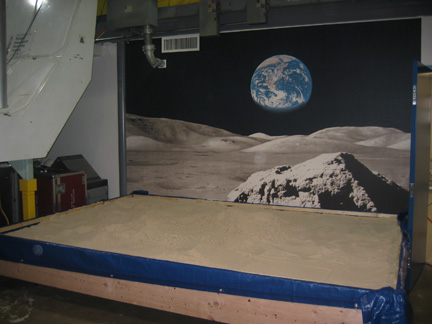
The Venue: We have created a simulated lunar landscape
in the Manufacturing Building. This will consist of a wooden frame enclosing
a sandy area 8 ft. by 12 ft. filled with 4-6 inches of playground sand, representing
the lunar regolith. You will get to stand next to the simulated surface and
control your robot via the Vex radio control.
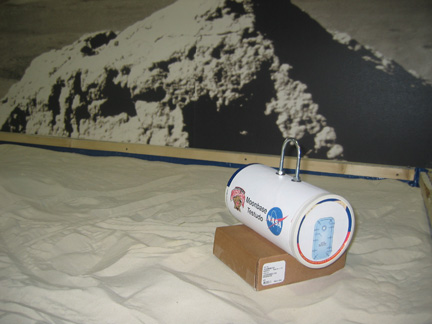
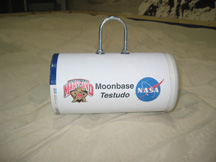
The Task: The habitat is cylindrical, 4.5 inches in
diameter and 10 inches long. It has just been landed on the lunar surface, and
is sitting on its rectangular lander vehicle 2 inches above the surface. On
the top of the habitat is a lifting structure, with a 1.5 inch clearance width
and a total height of 2.5 inches. The habitat has to be lifted by at least 0.5
inches to clear the lander deck.
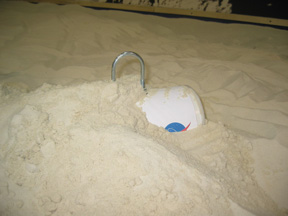
The habitat needs to be buried in the sand to a depth of 1 inch
over the entire surface of the habitat. Your robot has to prepare a site, pick
the habitat up off the landing vehicle by either "scooping" underneath
it or by lifting it by the U-shaped handle at the center of the top surface,
transport it to the prepared site and cover it with soil. You are free to decide
on your own approach to burying the habitat - dig a deep trench and fill it
in over the habitat, trench halfway and cover the top half, or lay the habitat
down on the surface and heap the soil into a mound over the habitat.
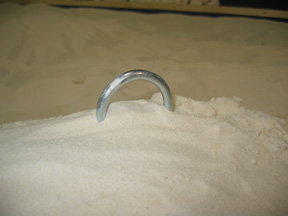
The habitat has to be buried to a minimum depth of 1 inch over the entire
surface. As a visual indicator, when the threads on the lifting fixture are
fully buried, the soil over the habitat is at least one inch thick.
The Competition: During the ENAE 100 poster session
on December 11, we will hold the Great Lunar Base Construction Challenge. Each
of the four groups will have 15 minutes to prepare the site, move the habitat
off the lander, and cover it with soil. There will be five minutes between trials
to move out the previous robot, replace the habitat on the lander and level
the soil, and place the next robot on the surface. The winning team will be
the one who best performs the habitat emplacement within the time limits, or
failing a complete process, the team which comes closest to completing the habitat
emplacement.
The Fine Print: The Vex kits should be in by the end
of next week (10/26). You are encouraged to complete your robot in time to test
on the surface repeatedly well before the competition on December 11, to make
sure your robot is well designed and your operator is well trained. The Manufacturing
Building is open during normal work hours on campus. You should try to use the
components in your Vex kit, but there will be a supply of additional components
available for your use on a lab bench next to the test site. No member of your
team will receive a passing grade in this class unless all Vex components (used
and unused) are turned in after the completion of the competition on December
11th.